It happens the same way every time. A friend pulls a lipstick from her bag, a creator blots something perfect in a video, a stranger on the train is wearing exactly the brick-red you've been hunting for two years — and the name is nowhere. The good news: you can now identify a lipstick from a photo, and often from far less photo than you'd think. A picture of the tube, a smear on the back of a hand, even the color on someone's lips can be enough for an AI lipstick identifier to name the brand, the product, and the shade.
The catch is that those three kinds of pictures are not created equal. This guide walks through each one — from easiest to hardest — plus how the AI actually reads them, why worn lipstick lies about its own color, and what to do once you have the name.
The three kinds of lipstick photos, easiest to hardest
1. The bullet and its packaging
A photo of the lipstick itself — cap on or off — is the closest thing to a guaranteed identification. Lipstick packaging is unusually distinctive: brands pour design money into cases precisely so you'll recognize them across a room. Cap shape, case color, logo placement, the proportions of the tube, even the angle the bullet is cut at all narrow the field fast. If the shade name or number printed on the base sticker is visible, you're essentially done. If not, the visible bullet color plus the case design usually gets a makeup identifier to an exact answer with high confidence.
2. The swatch
A swatch — that stripe on the back of a hand or a wrist — trades design clues for pure color. It's still very workable: a swatch in decent daylight shows the shade's true depth, its undertone, and its finish (a matte edge dries down differently than a gloss or a shimmer, and AI picks up on that texture). What a swatch can't do is distinguish between the many near-twins on the market. Every major brand makes a blue-red, a rosy nude, and a 90s brown; a swatch narrows you to a shortlist, and the shortlist is where confidence scores earn their keep.
3. Worn on lips
The hardest case — and the most common one, because it's how lipstick actually appears in the wild. Worn color is a blend: the product, the person's natural lip pigment underneath it, the lighting, how long it's been on, and whether it was blotted, layered, or topped with balm. An AI lipstick shade finder can still place the shade family and rank likely candidates, but from lips alone you should expect a well-ranked shortlist rather than a single certain name. We cover the general version of this problem in our guide to identifying makeup from a photo — lipstick is simply its most extreme case, because no other product changes this much between the tube and the face.
TRY IT YOURSELF
That lipstick has a name — find it in seconds.
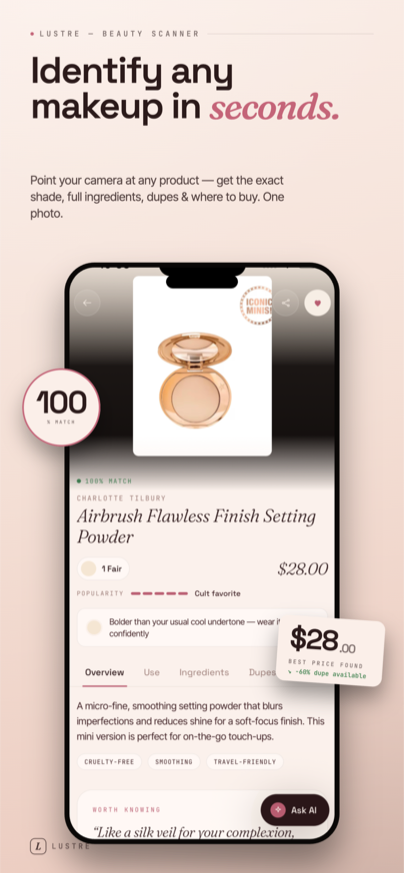
Snap or upload any picture — bullet, swatch, or a screenshot from a video — and True Shade identifies the brand, product, and exact shade with a confidence score, then checks it against your undertone and lines up cheaper dupes.
Download True Shade freeHow AI identifies a lipstick from a photo
Under the hood, a lipstick scan is a recognition problem layered on a color problem. Given your picture, the AI works through roughly four passes:
- Object detection. It finds the lipstick in the frame — a tube on a vanity, a bullet mid-application, a swatch against skin — and separates it from the background.
- Design reading. For packaging shots, it reads the visual signature: case geometry, logo, typography, cap finish, and any embossing. Embossing is a quiet superpower here — many brands stamp their logo or a monogram directly into the bullet's surface, and that stamp survives even when the sticker and cap are out of frame.
- Color and finish analysis. It samples the visible product color, corrects for the photo's lighting as far as possible, and classifies the finish — matte, cream, satin, gloss, metallic — since finish splits otherwise identical shades.
- Database matching. Everything gets compared against a product library — True Shade's covers 10,000+ recognized products — and the results come back ranked, each with a confidence score so you can see how sure the match is.
The practical upshot: the more of those signals your photo contains, the sharper the answer. A slightly blurry shot that includes the case will usually beat a crisp shot of color alone. If you're working from a video, pause on the frame where the product itself appears — creators almost always flash the tube — and screenshot that. The same logic applies to any product, not just lipstick; our guide to finding a makeup product from a picture covers screenshots, mirror shots, and shelf photos in more detail.
Why worn lipstick lies about its color
If you've ever bought the exact lipstick someone was wearing and found it looked different on you, nothing went wrong with the identification. Two forces shift worn color, and it pays to know both:
- Lighting. Warm indoor light pushes every lipstick toward orange; cool daylight pulls it toward blue and pink; golden-hour photos and ring lights flatter shades into something the tube never contained. A red that reads tomato in a café can read cherry by a window.
- Lip pigment. Lipstick is semi-translucent in practice. The wearer's natural lip color — deeper, pinker, or more mauve than yours — mixes with the formula from underneath, so the same bullet genuinely produces different colors on different mouths. Blotting, layering, and fading through the day compound it.
Two habits protect you. First, when you scan a worn-color photo, prefer frames shot in even, neutral light and treat the result as a ranked shortlist. Second, before buying, check the identified shade against your own coloring rather than the wearer's — a shade that sang on someone with cool-toned lips can go flat on warm ones. Our guides to choosing a lipstick shade for your skin tone and finding your perfect lipstick shade pick up exactly there. True Shade builds this check in: a 60-second undertone quiz up front, and every scan afterward graded against your warm, cool, or neutral result.
From name to dupe
Naming the lipstick is often only half the errand — the named lipstick may be discontinued, sold out, or simply more than you want to spend on a color you'll wear twice. This is where identification quietly becomes find lipstick shade arithmetic: once the product is known, its shade is a precise color value, and color values can be compared across every brand at once.
A good scanner does this automatically. Identify the original, and True Shade ranks cheaper alternatives across 600+ brands by shade-match percentage — so "95% match" means something concrete, not a vibe — alongside the ingredient list with risk flags, in case the dupe's formula is the dealbreaker. If you're curious how reliable this whole category of tools is, we've written a straight answer to whether AI can really identify makeup products.
The short version
- You can identify a lipstick from a picture of the bullet, a swatch, or worn color — in descending order of certainty.
- Packaging photos are gold: case design and embossing narrow the match faster than color ever can.
- Swatches identify the shade family well; expect a shortlist, since every brand makes a near-identical red.
- Worn color is a blend of product, lip pigment, and lighting — scan the best-lit frame and read the confidence score.
- Once named, the shade becomes a color value — which is what makes cross-brand dupes rankable by match percentage.