You've seen the party trick: point a phone at a lipstick with a worn-off label, and a few seconds later the screen names the brand, the product line, and the shade. It looks like magic, but an AI makeup identifier is doing something quite legible once you break it apart — reading shapes, reading text, and cross-referencing what it finds against a very large catalog of known products.
This article walks through each of those steps, explains what a confidence score actually tells you, and is honest about where AI makeup identification works brilliantly and where it still fails. If you're after the practical how-to instead, start with our guide to identifying makeup from a photo.
What an AI makeup identifier actually sees
To a scanner, your photo isn't "a lipstick" — it's a grid of pixels that certain patterns keep showing up in. Modern image-recognition models are trained on enormous numbers of product images, and through that training they learn which visual features distinguish one product from another. For makeup, the strongest signals are:
- Packaging geometry. The silhouette of a foundation bottle, the taper of a mascara wand's cap, the proportions of a compact. Brands invest heavily in distinctive packaging, which is exactly what makes it machine-readable.
- Color and finish. A matte black tube reads differently from brushed gold or frosted glass. Cap color often encodes the product line within a brand.
- Logos and embossing. Many lipstick bullets carry the brand's logo pressed into the product itself — which is why a scanner can sometimes identify a bullet even after the sticker on the base has worn away.
- Layout fingerprints. Where the brand name sits, how the shade name is typeset, whether the label wraps the bottle — the composition of a label is nearly as distinctive as the words on it.
None of these signals is decisive alone. The model weighs all of them at once, which is why a scanner can recover an identification even when one clue — a scuffed logo, a missing cap — is gone.
Reading the label: where text recognition takes over
Shape narrows the field; text usually closes the case. Alongside image recognition, an AI makeup scanner runs optical character recognition — reading the actual characters printed on the packaging. That's how it distinguishes between two shades of the same foundation in the same bottle: the silhouette is identical, but the label says 2N1 on one and 3W2 on the other.
Text recognition is why label-side photos outperform glamour angles. A crisp shot of the printed shade code, batch text, or base sticker gives the scanner a near-certain anchor, and the image recognition then confirms the packaging matches. It also explains a common failure: curved bottles, metallic foil printing, and tiny base stickers are hard to read at a distance, so blur or glare on the text costs more accuracy than blur anywhere else in the frame. We cover the best angles to shoot in our guide to finding a makeup product from a picture.
The shade database: turning a match into an answer
Recognition alone would only get you "this looks like a foundation from brand X." The useful answer — which product, which shade, what's in it — comes from the database the scanner checks its findings against. A serious makeup product identifier maintains a catalog of products with their full shade ranges, each shade stored as a real color value rather than just a marketing name.
That color-value layer is what unlocks the second act of makeup identification: comparison. Once a product's shade exists as a point in color space, the scanner can measure the distance between it and every other shade in the catalog — across brands. That's the machinery behind dupe-finding, and behind checking a product against your coloring rather than in a vacuum. True Shade, for instance, recognizes 10,000+ products and ranks cheaper alternatives across 600+ brands by shade-match percentage, then checks every result against the undertone you recorded in its 60-second quiz.
SEE IT IN ACTION
Point, scan, and it's named.
True Shade identifies the brand, product, and exact shade from one photo — with a confidence score, ingredient flags, and cheaper dupes ranked by shade match.
Try True Shade freeWhat a confidence score really means
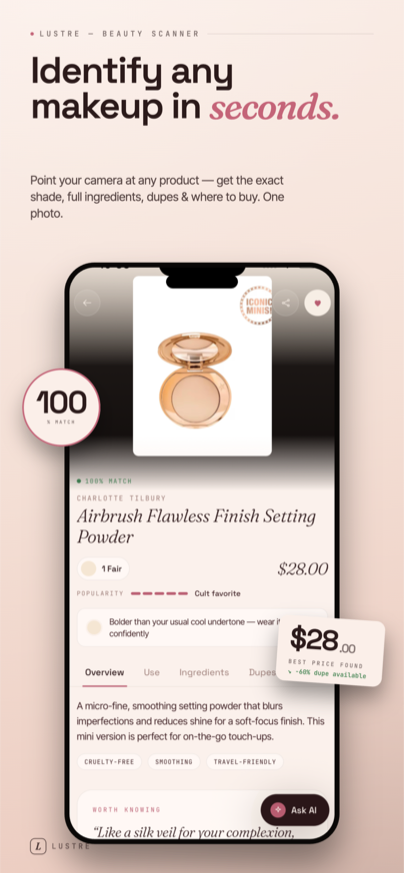
Good scanners don't just hand you an answer — they tell you how sure they are. A confidence score reflects how strongly the evidence in your photo converged on one product: legible shade code plus matching packaging plus matching logo yields a high score; a partial silhouette with no readable text yields a low one.
Read it the way you'd read a weather forecast:
- High confidence — the scanner found multiple independent signals agreeing. You can act on it: buy the refill, hunt the dupe.
- Medium confidence — the product family is probably right, but the specific shade or edition may not be. Retake the photo with the label facing the camera.
- Low confidence — treat the result as a lead, not an answer. Check the suggestion against the product yourself before spending money.
A tool that admits uncertainty is more trustworthy than one that always sounds sure. If a scanner never shows you a low-confidence result, it isn't more accurate — it's just hiding the cases where it guessed.
How accurate is AI makeup identification — honestly?
With a clear, well-lit photo of a branded product, identification is genuinely strong: the combination of packaging recognition and text reading pins down brand and product reliably, and the shade follows wherever a code or name is visible. Foundations and lipsticks are the friendliest cases — foundations because of their printed shade codes, lipsticks because of their distinctive bullets and cases. We go deeper on the lipstick case in how to identify a lipstick from a picture.
And here is where AI still stumbles, no matter whose scanner you use:
- Decanted and depotted products. Powder pressed into an unbranded palette carries none of the packaging signals. Without a label, even a perfect model is guessing from color alone.
- Brand-new and region-exclusive releases. A database can only match what it contains. A product launched last week, or sold only in one market, may not be indexed yet.
- Swatches and worn makeup. Identifying a product from a swatch on skin — or from lips in a selfie — is a much harder problem than identifying its packaging, because skin tone, lighting, and application all shift the color. Expect a shortlist, not a certainty.
- Lookalike packaging. Minimalist white-and-black tubes have converged across brands; sometimes only the fine print separates them, and the fine print must be in focus.
- Counterfeits. A good fake is designed to fool the same visual cues the AI reads. A scanner identifies what a product appears to be, not whether it's genuine.
The practical takeaway: the photo is half the system. Fill the frame with the product, get the label sharp, and shoot in even light, and you'll sit at the accurate end of every range above.
Beyond naming: what identification unlocks
Naming the product is rarely the end goal — it's the key that opens everything else. Once a scanner knows exactly what it's looking at, it can pull the ingredient list and flag risks, check whether that particular shade suits a warm, cool, or neutral undertone, and line up similar products at lower prices. That last step matters most when the product you identified is out of budget or discontinued; the same color-value matching that names a shade can rank its nearest neighbors across the market. And identification works in the other direction too — if your question is about your own skin rather than a product, a photo can also find your foundation shade before you ever pick up a bottle.
The short version
- Yes, AI can identify makeup products — by combining packaging recognition, logo and embossing detection, and text reading, then checking results against a product database.
- Text is the strongest single signal: a legible shade code usually settles brand, product, and shade at once.
- Confidence scores are a feature, not a hedge — they tell you when to act and when to retake the photo.
- Limits are real: unbranded decants, brand-new releases, swatch-only photos, and counterfeits all reduce accuracy.
- Identification is the doorway to the useful part: ingredients, undertone checks, and cheaper shade-matched dupes.