Everyone has one: the screenshot of a blush you never tracked down, the mystery compact from a friend's bathroom shelf, the lipstick a stranger on the train was wearing better than anyone has ever worn anything. Trying to find a makeup product from a photo is one of the most common dead ends in beauty — not because it's impossible, but because people usually pick the wrong tool for the picture they have.
There are four routes that actually work: reverse image search, asking the internet, brand-site detective work, and AI makeup scanners. Each one suits a different kind of picture. This guide walks through all four, so you can match your photo to the method that will actually name it.
First, look at what your picture shows
Before you choose a tool, be honest about your evidence. Every attempt to identify a makeup product starts from one of two kinds of image:
- The product itself — packaging in frame, even partially. A tube on a vanity, a palette in a haul video, a compact in someone's hand.
- The product in use — makeup on a face, with no packaging in sight. A red lip in a film still, an eyeshadow look on a creator.
This distinction decides everything. Packaging carries identity — shape, cap, embossing, typography — and machines are good at reading it. Makeup on skin carries only color and finish, both of which shift with lighting, skin tone, and layering; naming a product from those alone takes human context. Keep this split in mind as we go through the routes.
Route 1: Reverse image search
Google Lens, Pinterest Lens, and similar tools compare your picture against billions of indexed images and shopping listings. They're free, instant, and already on your phone — the obvious first move to search makeup by photo.
When it works: distinctive packaging photographed clearly. A sculptural perfume-style bottle, an unusual palette, a cult product that's been photographed ten thousand times — reverse search will often surface it in seconds, along with places to buy it.
When it fails: the moment the packaging is generic. Most lipsticks are black or gold cylinders; most foundations are rectangular pumps. Reverse search returns "visually similar" results — fifty products that look like yours without being yours. And it's nearly useless for shade: even if it finds the right product line, it can't tell a 120 from a 130. It also struggles badly with makeup worn on a face, where it tends to return other faces rather than products.
Route 2: Ask the internet
Beauty communities on Reddit, comment sections under tutorials, and DMs to the creator themselves remain remarkably effective — because humans recognize context that machines can't. A regular in a makeup forum has seen that exact jelly-blush texture before, knows which brand does that doe-foot applicator, remembers that this creator wears one particular brand's skin tint in every video.
When it works: makeup in use, with no packaging. If your picture shows a finished look, human eyes are your best shot — especially if you can add details: where you saw it, the finish (matte, satin, glossy), the setting's lighting. Pinned comments and video captions are worth checking first; creators often tag products and the answer is already sitting there.
When it fails: when you need an answer today. Forum posts can sit unanswered for days, creators get hundreds of comments, and well-meaning guesses arrive with total confidence and no accuracy. You'll also get five different answers and no way to rank them.
SKIP THE HUNT
Name that product in seconds.
True Shade is a makeup product finder in your pocket: snap or upload a picture and get the brand, product, and exact shade with a confidence score — plus cheaper dupes ranked by shade match.
Download True Shade freeRoute 3: Brand-site detective work
Sometimes your picture gives you a partial lead — a legible logo, a distinctive cap, half a product name — and the rest is a catalog hunt. You go to the brand's site, open the category, and scroll the grid until something matches.
When it works: when you already know the brand and just need the specific product or shade. If you can read "Maybelline" on the tube, scrolling their lip products page is genuinely quick. Shade-name hunting also works here if your photo shows the swatch sticker on the base of the product — that tiny dot of color plus a printed name is the whole identity.
When it fails: as a starting point. With no brand lead, you're scrolling through hundreds of near-identical listings across dozens of sites, and discontinued or region-exclusive products won't be on the current catalog page at all. It's a fine last mile, and a terrible first one.
Route 4: AI makeup scanners
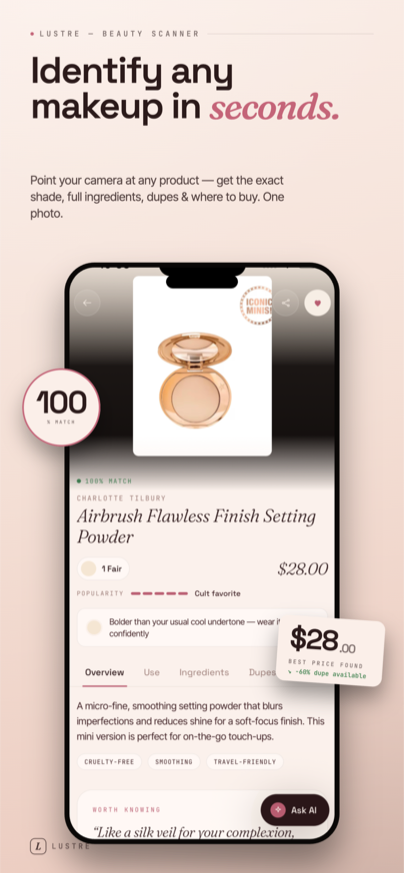
A dedicated makeup scanner is a different animal from general reverse image search. Instead of comparing your picture against the whole internet, it's trained specifically on beauty products — packaging, typography, shade systems — so it can go from a photo to a precise answer: brand, product line, and the exact shade, with a confidence score telling you how sure it is. We've written a deeper explainer on how AI makeup scanners actually work if you want the mechanics.
When it works: any time the product itself is in the picture, even imperfectly — a scan of a friend's foundation bottle, a screenshot from a haul video, the back of a palette with the label half-visible. True Shade, for example, recognizes 10,000+ products, then goes past the name: it checks the shade against your undertone from a 60-second quiz, surfaces the ingredient list with risk flags, and lines up cheaper dupes across 600+ brands ranked by shade-match percentage. This matters because finding the product is rarely the end of the story — usually you're deciding whether to buy it.
When it fails: the same place every machine does — makeup worn on a face with no product in frame. A makeup identifier can tell you a great deal about a photographed lipstick bullet; it cannot reliably reverse-engineer which of forty near-identical reds is on someone's lips. For that, route 2 is still king. Our guide to identifying makeup from a photo covers how to get the most out of a scan, and there are product-specific walkthroughs for foundations and lipsticks.
Which route for which picture?
Here's the decision, condensed:
- Packaging in frame, distinctive product — reverse image search or an AI makeup scanner. The scanner wins on shade precision.
- Packaging in frame, generic-looking product — AI makeup scanner. Reverse search will drown you in lookalikes.
- Brand known, product unknown — brand-site hunting, with the photo open in a second tab.
- Makeup on a face, no packaging — captions and pinned comments first, then forums and the creator's comments. Machines can't read minds yet.
And a habit worth building: the more of these hunts you run, the more you realize the real question underneath is rarely "what is this product?" — it's "would this product work on me?" A shade that's stunning on the person in your screenshot may fight your undertone entirely. If you haven't pinned yours down, start with our guide to finding your skin undertone; it turns every future identification into an instant yes-or-no.
The short version
- Match the method to the picture: packaging photos suit machines, on-face photos suit humans.
- Reverse image search is fast for distinctive packaging but can't tell shades apart.
- Forums and comments are unbeatable for makeup worn on a face — just slow.
- Brand-site hunting works when you already know the brand; it's a last mile, not a first step.
- An AI makeup scanner is the most precise route when the product is in frame — brand, product, exact shade, and whether it suits you.