Every lipstick wall looks the same at first: fifty tubes of red, pink, and brown that blur into one another under store lighting. But choosing a lipstick shade for your skin tone is not actually a fifty-way decision. It's two decisions. Your undertone narrows the wall down to a color family. Your skin's depth tells you how intense a version of that family to pick. Answer those two questions once, and the wall stops being a gamble.
This guide walks through both — what skin tone and undertone each control, the shade families that flatter warm, cool, and neutral undertones, and how to land on the red that people will assume was made for you.
How your skin tone shapes your lipstick shade
"Skin tone" gets used loosely, but for lipstick it helps to split it into its two working parts:
- Depth is how light or deep your skin is — fair, light, medium, tan, deep. It shifts with the seasons and with sun. Depth governs intensity: how much pigment and contrast a lip color needs before it reads as intentional rather than washed out, or as wearable rather than stark.
- Undertone is the hue underneath — warm (golden, peachy), cool (pink, rosy, blue), or neutral (a balance). It doesn't change when you tan. Undertone governs color family: whether a red should lean tomato or cherry, whether your nude should be caramel or rose.
Foundation matching obsesses over depth because foundation has to disappear into your skin. Lipstick is the opposite — it sits next to your skin and is meant to be seen. That's why undertone does most of the work here: a lipstick doesn't have to match you, it has to harmonize with you. When it shares your undertone's temperature, your skin looks clearer and your teeth look whiter. When it fights it, the whole face tilts sallow or ashen, even if the color is beautiful in the tube.
If you're not sure which undertone you are, the vein check, the jewelry test, and a few better methods are covered in our guide to warm vs cool vs neutral undertones. Settle that first — everything below builds on it.
The best lipstick shades for each undertone
Think of lip colors as a map. Warm undertones own one region, cool undertones own another, and neutral undertones hold a passport to most of it.
Lipstick for warm undertones
Warm skin has gold in it, so it's flattered by lipsticks that carry gold too. The lipstick for warm undertones region of the map includes:
- Brick and terracotta — earthy reds with brown-orange warmth; the signature warm-undertone territory.
- Warm reds — tomato, poppy, orange-leaning reds that make golden skin glow.
- Coral and peach — from soft peachy pinks to full coral, natural daytime range.
- Golden nudes — caramel, honey, warm beige rather than pink-beige.
What tends to fight warm skin: icy blue-pinks, true purple-berries, and stark blue-reds, which can make golden skin look yellowed by contrast. That doesn't mean never — it means when a warm-toned person wants a berry, a warmed-up version (raspberry over grape) usually bridges the gap.
CHECK ANY LIPSTICK
Is that lipstick actually your shade?
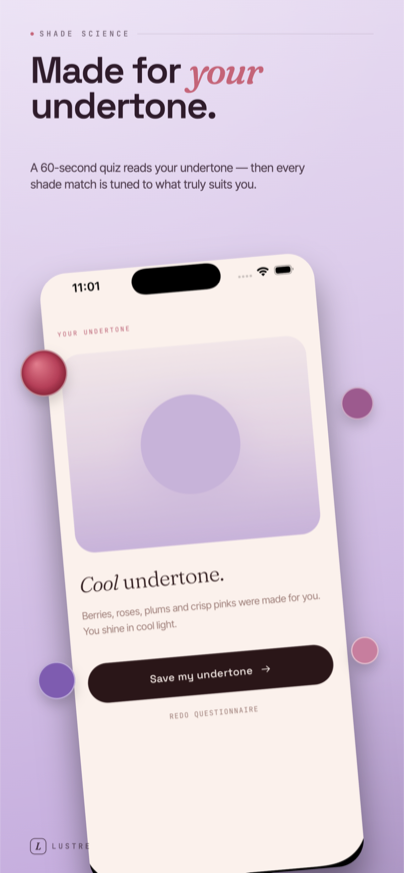
Take True Shade's 60-second undertone quiz once, then scan any lipstick — in a store, in a friend's bag, in a screenshot. The app names the exact product and shade, tells you whether it suits your undertone, and lines up cheaper dupes ranked by match.
Download True Shade freeLipstick for cool undertones
Cool skin carries pink and blue beneath the surface, and it lights up when lipstick does the same. The cool-undertone region:
- Berry and raspberry — the cool equivalent of warm skin's brick; rich without effort.
- Blue-reds — cherry, cranberry, wine. The classic "red lip" of old Hollywood is a blue-red for a reason: it flashes teeth whiter.
- Mauve and plum — dusty rose-purples that read as sophisticated neutrals on cool skin.
- Rosy pinks and pink nudes — for low-key days, a nude leaning pink rather than caramel.
What tends to fight cool skin: heavy orange — true coral, terracotta, brown-gold nudes — which can pull rosy complexions sallow or gray. Again, it's a lean, not a law: a cool-toned person who loves warm tones can often wear a red that sits dead-center between tomato and cherry.
Lipstick for neutral undertones
Neutral undertones are the map's frequent flyers: both brick and berry sit comfortably, because neither temperature clashes with skin that holds warm and cool in balance. If that's you, your choice shifts from "which family?" to "which effect?" — a warm-leaning shade will make you look sunnier and more casual; a cool-leaning one reads crisper and more formal. Rose, mauve-brown, and soft red are especially easy defaults because they're temperature-balanced themselves.
One caution for neutrals: the extreme ends of the map — neon coral, iciest fuchsia — can still overwhelm, not because of temperature but because of sheer saturation. Which brings us to depth.
How depth changes the intensity you choose
Once undertone has picked your color family, depth decides how much of it to wear. The principle is contrast: a lip color stands out in proportion to how far it sits from your skin's own depth.
- Fair to light skin creates high contrast with almost any pigmented lipstick, so even a medium berry reads as a statement. Deep vampy shades can veer gothic fast — beautiful when that's the goal, a lot when it isn't. Sheer formulas and stains give fair skin the same colors at a gentler volume.
- Medium and tan skin has the widest comfortable range — enough depth to anchor rich brick, cranberry, or bold rose, enough lightness that brights still pop. The main trap is too-pale nudes, which can flatten the face into one beige plane.
- Deep skin carries saturation that lighter skin can't: oxblood, espresso-brown, deep plum, and vivid tomato all wear as elegantly as a nude does on fair skin. Pale, milky pastels are the shades to audition carefully — they often turn chalky against rich depth, while a jewel-toned version of the same color sings.
Depth is also why "one shade, two friends" experiments go sideways. The same terracotta can be a bold lip on a fair warm-toned person and a barely-there nude on a deep warm-toned person. Neither reading is wrong; they're just different distances from the wearer's own depth.
Finding your red
Everyone has a red — the one that looks less like makeup and more like a fact about you. The search is short once you frame it as coordinates:
- Set the temperature by undertone. Warm skin: start at tomato and brick. Cool skin: start at cherry and cranberry. Neutral: start at a balanced true red and lean either way.
- Set the darkness by depth. Lighter skin usually finds its red in the bright-to-medium band; deeper skin can go from bright vermilion all the way to oxblood without losing the "red" effect.
- Test on your face, not your hand. The back of your hand is a different color and undertone than your lips. Check the shade near your mouth in daylight, and look at your teeth and jawline: the right red brightens both.
When you spot the right red on someone else — a friend, a stranger, a face in a video — you don't have to reverse-engineer it from memory. A photo is enough to identify a lipstick from a picture, down to brand and shade name, and True Shade will tell you whether that exact shade suits your undertone or point you to the nearest version that does — with cheaper dupes across 600+ brands if the original stings.
And if you're still second-guessing your undertone call, a quick undertone check is worth doing before you buy anything — it's the one answer that upgrades every future lipstick decision, not just this one. From there, our guide to finding your perfect lipstick shade covers the finer points: finish, formula, and building a small wardrobe of shades instead of a drawer of near-misses.
The short version
- Undertone picks your color family; depth picks your intensity. Two decisions, not fifty.
- Warm undertones: brick, terracotta, coral, warm reds, golden nudes.
- Cool undertones: berry, mauve, plum, rosy pinks, blue-reds.
- Neutral undertones: most of the map — choose by mood and saturation instead.
- Fair skin turns the volume up on any pigment; deep skin carries saturation lighter skin can't. Match intensity to your depth.
- Your red exists: set its temperature by undertone, its darkness by depth, and test it on your face in daylight.