Every foundation shade, every lipstick, every blush you'll ever buy is quietly sorted into three families: warm, cool, and neutral. Pick from the right family and makeup disappears into your skin. Pick from the wrong one and even a perfectly deep-enough foundation goes orange, ashy, or oddly flat. The warm vs cool vs neutral undertone question isn't beauty trivia — it's the single decision that makes every other shade decision easier.
This guide walks through what each undertone actually looks like in real skin, the fast tests that separate them, and the foundation, blush, and lipstick shades that flatter each one.
Skin tone vs undertone: two different questions
People use the terms interchangeably, but skin tone and undertone answer different questions, and mixing them up is where most shade mistakes begin.
- Skin tone is surface depth — fair, light, medium, tan, deep. It changes with sun exposure, season, even how well you slept. It answers: how light or deep should my foundation be?
- Undertone is the hue underneath — golden, rosy, or balanced. It's set by the mix of pigments in your skin and it doesn't change with a tan. It answers: which version of that depth will look like me?
That's why two people can wear the same depth of foundation and need completely different shades of it, and why a shade that matched your arm in the store can still look wrong on your jaw. Depth was right; undertone wasn't. If a past foundation ever turned orange or went grey and ashy on you, undertone is almost always the culprit.
Warm undertones: golden, peachy, sun-loving
Warm undertones read golden, yellow, or peachy beneath the surface. Warm skin exists at every depth — fair skin can be warm, and so can deep skin; the gold runs through all of it. If your bare face tends to look its best in late-afternoon light, or friends describe your coloring as "sunny" even in winter, you're probably in this family.
Signs you're warm
- The veins at your wrist look more green than blue in daylight.
- Gold jewelry flatters you more obviously than silver.
- You tan easily and rarely burn first.
- Ivory and cream whites suit you better than stark, bluish white.
Warm undertone makeup
For warm undertone makeup, stay in the golden half of the aisle: foundations marked W, G, or Y (warm, golden, yellow), blushes in peach, apricot, and terracotta, and lipsticks with an orange or brick base — warm reds, corals, caramel nudes. Cool pink blush and blue-based red lipstick tend to fight warm skin rather than lift it.
Cool undertones: rosy, pink, berry-friendly
Cool undertones read pink, red, or faintly bluish beneath the surface. Again, depth is irrelevant: porcelain skin can be cool and so can rich, deep skin with a red or blue cast. Cool skin often photographs a touch rosier than it looks in the mirror, which is why cool-toned people are the most frequent victims of yellow-heavy "universal" shades.
Signs you're cool
- Your wrist veins look blue or purple rather than green.
- Silver and platinum jewelry looks more natural on you than gold.
- You burn or flush before you tan.
- Crisp, bright white flatters you more than ivory or cream.
Cool undertone makeup
For cool undertone makeup, look for foundations marked C, R, or P (cool, rosy, pink), blushes in soft pink, berry, and plum, and lipsticks with a blue base — true blue-reds, fuchsias, mauves, rosy nudes. Yellow-based foundation is the classic cool-skin mistake: it can drag rosy skin toward orange within an hour of wear.
SETTLE IT IN 60 SECONDS
Stop guessing your undertone. Test it.
True Shade's 60-second quiz reads whether you're warm, cool, or neutral — then checks every foundation, blush, and lipstick you scan against your result, with dupes ranked by shade match.
Download True Shade freeNeutral undertones: the balanced middle
Neutral undertones sit between the two — neither clearly golden nor clearly rosy, but a genuine mix. If you've taken every test and keep landing on "both" or "neither," that's not a failed result. It's your result.
Signs you're neutral
- Your veins look blue-green, or you honestly can't call it.
- Gold and silver jewelry look equally good on you.
- You tan gradually but can still burn.
- Both warm ivory and crisp white sit fine against your face.
Neutral undertone makeup
For neutral undertone makeup, foundations marked N are the home base, and you enjoy the widest margin for error: slightly warm and slightly cool shades at your depth usually both work. In color, neutrals can borrow from either family — soft rose and peach blushes, and lipsticks from warm coral to cool berry — as long as the shade isn't at the extreme end of warm or cool. Some people also fall into olive territory, a green-leaning cast that behaves like neutral in most shade systems but can make overly pink foundations look chalky.
The quick tests, side by side
No single test is conclusive on its own — vein color varies with skin depth and lighting, and jewelry preference is partly habit. Run three or four and look for a majority verdict:
- Vein check. In indirect daylight, look at your inner wrist. Green suggests warm, blue-purple suggests cool, a genuine mix suggests neutral.
- Jewelry test. Hold gold against one side of your face and silver against the other in a mirror. Whichever makes your skin look brighter — not just whichever you like — is your answer.
- White t-shirt test. Stark white next to your bare face flatters cool skin; ivory or cream flatters warm skin; if both look fine, you're likely neutral.
- Sun response. Tan-first skin leans warm; burn-first skin leans cool. Treat this as a supporting clue, not a verdict.
There's also the most direct test of all, if you have products on hand: the swatch test. Blend a warm-leaning and a cool-leaning foundation of the same depth side by side on your bare jawline, step into daylight, and wait ten minutes. One will quietly vanish into your skin; the other will announce itself as a stripe. Skin doesn't lie about this — it just needs the right light and a little patience.
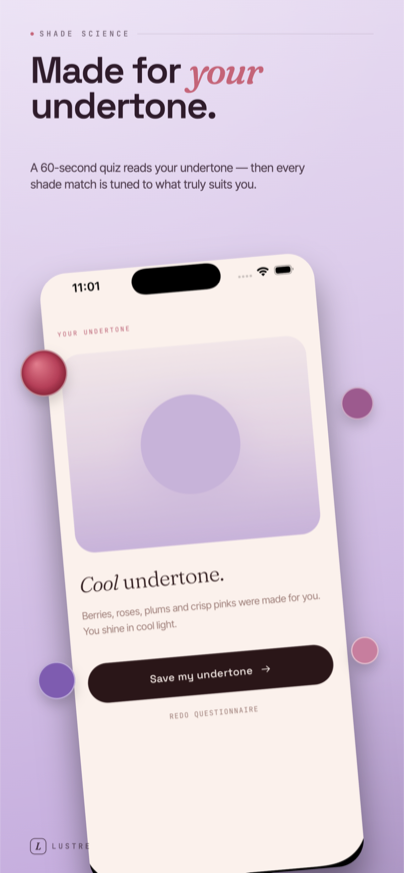
If the tests still feel ambiguous, a photo can settle it: an undertone quiz that reads your skin in neutral light removes the squinting-at-veins guesswork. We walk through the full at-home process, edge cases included, in our guide to finding your skin undertone.
What your undertone changes in practice
Once you know your family, the payoff shows up everywhere:
- Foundation stops being a lottery. You can skip half the shade wall immediately and judge the rest at your depth — our guide to matching foundation to your skin tone picks up from here.
- Lipstick gets dramatically easier. The same red comes in orange-based and blue-based versions, and your undertone tells you which will make your teeth look whiter. More on that in choosing lipstick for your skin tone.
- Blush and bronzer stop going muddy, because you're no longer warming up cool skin or cooling down warm skin by accident.
- Shopping from photos becomes reliable. When True Shade identifies a product you've scanned, it checks the exact shade against your undertone before you spend anything — the difference between "pretty in the picture" and "pretty on you."
One reassurance worth repeating: your undertone doesn't change. A tan deepens your surface tone — you might move from shade 2 to shade 3 in summer — but a warm 2 becomes a warm 3, not a cool one. Learn the family once and it holds for life.
The short version
- Skin tone is depth (how light or deep); undertone is hue (golden, rosy, or balanced). You need both to match makeup.
- Warm: green-ish veins, gold jewelry, tans easily — reach for golden foundations, peach blush, warm reds.
- Cool: blue-purple veins, silver jewelry, burns first — reach for rosy foundations, berry blush, blue-based reds.
- Neutral: mixed signals across every test — N-labeled foundations, and the freedom to borrow from both families.
- Run three or four tests and take the majority verdict; your undertone stays fixed even when your tan doesn't.