You found your depth. The bottle looked right in the store, maybe even right on the back of your hand. Then you wore it for an hour and your face turned faintly grey — dull, flat, a little dusty, like the color had been drained out of your skin. If you've wondered why foundation looks grey on you, the answer is almost never the obvious one. It isn't that the shade is "too dark" or "too light" in the usual sense. It's that the shade is the wrong temperature.
Greyness is, overwhelmingly, an undertone problem. And because of how color mixing works, it lands hardest on medium-deep and deep skin tones. This guide walks through the main culprit, the three lesser suspects, and exactly how to fix each one.
Why foundation looks grey: it's an undertone problem
Every skin tone is built from two ingredients: depth (how light or deep you are) and undertone (the hue underneath — warm and golden, cool and pink, or neutral). Foundations are built the same way. A match only works when both line up.
Here's the mechanism. Warm skin carries visible gold, yellow, and red notes. A foundation that's too cool — or a flat, colorless "neutral" — doesn't just fail to add warmth; it actively mutes the warmth your skin already has. In color terms, cool pigment plus warm skin averages out toward grey. That's why the effect is often described as ashy: the foundation is literally desaturating you.
The reverse mistake exists too — warm foundation on cool skin — but it fails differently: it goes orange or muddy rather than grey. (If that's your problem, our guide to why foundation looks orange covers it.) Grey and ashy is the signature of a wrong foundation undertone in the cool direction.
Why it hits medium-deep and deep skin hardest
On fair skin, warmth is a small share of the total color, so a slightly-too-cool foundation reads as merely "a bit flat." On medium-deep and deep skin, golden, red, and olive undertones make up much more of what you actually see — so when a foundation cancels them, the loss is dramatic. This is compounded by a practical problem: many shade ranges thin out at the deep end, and the deep shades that do exist are often mixed with grey or black pigment instead of the rich red and golden bases deep skin usually needs. If your deeper foundation consistently goes ashy, the formula's base pigments — not your application — are usually to blame.
How to tell if undertone is your culprit
- The foundation looks grey everywhere, not just where you powdered — and it's visible in person, not only in photos.
- Your bare jawline or neck looks warmer and more alive than your foundation-covered cheek.
- Gold jewelry flatters you, you tan rather than burn, or your veins look greenish — classic warm-undertone tells. (Not sure? Take five minutes with our guide to finding your skin undertone.)
- The shade name or code leans cool or neutral: think "C," "cool," "rose," "porcelain," or a bare number with no warmth marker.
If two or more of those ring true, you don't need a different depth — you need the same depth with more warmth in it.
CHECK BEFORE YOU BUY
Stop guessing your undertone.
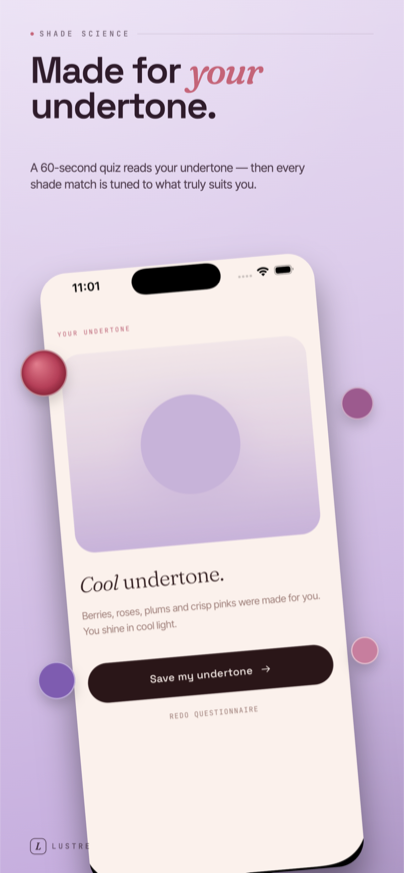
True Shade reads your undertone with a 60-second quiz, then checks every foundation you scan against it — so a too-cool, ash-prone shade gets flagged before it ever touches your face.
Download True Shade freeThe three lesser suspects
If your undertone checks out and your makeup looks grey anyway, work through these in order.
1. The shade is simply too light
A foundation one or two depths too light doesn't read as "pale" on medium-deep and deep skin — it reads as grey, because lightening a rich skin tone without keeping its warmth pushes it toward chalk. This is the classic result of matching to the back of your hand, or to a face that's lighter than your neck and chest. Match on the jawline, in daylight, and when in doubt between two shades, take the deeper one — our guide to matching foundation to your skin tone walks through the whole routine.
2. SPF and titanium dioxide white cast
Mineral sunscreen filters — titanium dioxide and zinc oxide — are brilliant white pigments. In a high-SPF foundation, they can sit on the skin as a faint pale film. On lighter skin it's nearly invisible; on deeper skin it's a visible grey veil, and under camera flash it becomes the infamous white-cast "flashback." If your foundation looks fine at noon but ghostly in every party photo, suspect the SPF, not the shade. Check the ingredient list: titanium dioxide high up the list on a deep shade is a warning sign. (Scanning a foundation with True Shade surfaces the full ingredient list, so you can spot this before checkout.)
3. Over-powdering
Powder mutes. That's its job — it kills shine by scattering light. But layer too much of it, especially a translucent powder with a white or pale base, and it scatters the color out of your base along with the shine. The result is a dull, grey, flat finish by mid-afternoon, often worst under the eyes where setting powder piles up. Use less, press rather than sweep, and on deep skin choose a tinted or "banana-free" translucent powder made for your depth.
How to fix ashy foundation, step by step
- Confirm your undertone first. Everything downstream depends on it. Warm, cool, or neutral — and on deep skin, note whether your warmth leans golden, red, or olive. Our comparison of warm vs cool vs neutral undertones makes the call quick.
- Re-match at the same depth, warmer. You usually don't need a darker foundation — you need one with a golden, red, or olive base at the depth you already wear. Look for "W," "warm," "golden," "amber," or "honey" markers in shade names.
- Rescue the bottle you own. Mix in a drop of a deeper, warmer shade or a warming adjuster before it hits your face. It won't make a wrong shade perfect, but it can make it wearable while you find the right one.
- Audit your SPF. For photographed events, switch to a low-SPF or SPF-free base and wear a separate chemical sunscreen underneath.
- Halve your powder. Set only the T-zone and under-eyes, press with a puff instead of buffing, and skip re-powdering over the day — blot oil with paper first.
- Judge in daylight, after ten minutes. Foundations shift as they set and interact with your skin's oils. A shade that looks right the second it's blended can still grey out — give it ten minutes near a window before you decide.
Choosing a foundation that won't grey out
The lasting fix is buying right the first time — which means shopping undertone-first, depth-second. Most people do it in the other order, and it's the single biggest reason returns drawers fill up with almost-right bottles.
In practice: settle your undertone once, then only audition shades that carry it. Swatch on the jawline, never the hand. Check the deep end of a range critically — if every deep shade in a line looks flat and grey-brown in the bottle rather than rich, that line wasn't built for you, whatever the marketing says. And read the base pigments where you can: deep shades built on red and golden pigment stay alive on skin; deep shades built by adding black or grey to a medium base are the ones that ash.
This is also where a scanner earns its place in your routine. Point True Shade at any foundation — in-store, in a friend's kit, in a screenshot — and it identifies the exact product and shade, checks that shade against your undertone quiz, flags the ingredients, and ranks cheaper dupes by shade-match percentage. The grey-foundation problem is, at its core, an information problem — and one photo carries all the information you need.
The short version
- Grey or ashy foundation is almost always a wrong foundation undertone: too-cool or flat-neutral pigment cancelling warm skin.
- The effect is strongest on medium-deep and deep skin, where warmth is a bigger share of the skin's visible color.
- Lesser culprits, in order: a shade that's too light, titanium dioxide white cast from high-SPF formulas, and over-powdering.
- Fix it by re-matching at the same depth with a warmer (golden, red, or olive) base — not by going darker.
- Shop undertone-first, swatch on the jawline in daylight, and wait ten minutes before trusting any shade.