A foundation that truly matches your skin tone should be boring. Applied and blended, it should do nothing dramatic at all — no line at the jaw, no grey cast by lunchtime, no orange tint in photos. Just your skin, evened out. Getting to that kind of foundation shade match isn't luck; it's a short checklist that most of us were never actually taught.
This guide walks through the whole thing: the two measurements that define your skin tone, where on your body a foundation match is actually decided, how to read the warning signs of a shade that's too light or too dark, and what to do when you're stuck between two.
A foundation shade match has two halves
Every skin tone — and every foundation shade made to meet it — sits at the intersection of two measurements:
- Depth is how light or deep your skin is: fair, light, medium, tan, deep, rich. This is the axis most people shop on, and the one shade names usually describe.
- Undertone is the hue underneath: warm skin leans golden or yellow, cool skin leans pink or red, neutral sits between. It doesn't change with sun or seasons the way depth does.
Here's the part that trips people up: undertone causes more failed matches than depth does. A foundation can be exactly your depth and still look wrong — too yellow, too pink, oddly flat — because its undertone argues with yours. If you've ever bought "your shade" and watched it turn sallow or ashy on your face, that was almost certainly an undertone miss, not a depth miss. If you haven't pinned yours down, start with our guide to finding your skin undertone; it's a one-time job that makes every future match easier.
Once you know both halves, brand shade names start to decode themselves. The letters in codes like NC25 or 2W1 are undertone flags; the numbers are depth. You're no longer guessing at poetry like "honey beige" — you're looking for your coordinates.
Where to test: the jawline decides everything
The classic mistake is swatching foundation on the back of your hand. Hands are darker, redder, and more weathered than faces — a match there tells you almost nothing. The second mistake is testing on the cheek alone, because a foundation that matches only your face can still be visibly wrong against your neck.
The place that settles it is the jawline, the border between face and neck. Here's the routine:
- Start with clean, moisturized skin. Old makeup or dry patches skew both the color and the finish of a test swatch.
- Stripe two or three candidate shades along your jaw, from cheek down onto the neck, and blend the edges lightly.
- Judge in daylight. Walk to a window or step outside. Store lighting — warm bulbs especially — can shift a shade by a full undertone. What matters is what your skin looks like where you actually live your life.
- Pick the stripe that disappears. The right shade vanishes into both face and neck within a minute. If you can still find it, it's not your match.
- Wear it before you commit. Some foundations oxidize — they darken and warm as they interact with your skin's oils over an hour or two. A shade that's perfect at the counter and orange by dinner is a known failure mode; we explain it fully in why foundation turns orange.
Face or neck, if they differ? Match toward the neck. Faces often run slightly darker or redder — sun exposure, flushing, skincare acids all contribute — and a foundation matched to the face alone gives you the telltale floating-head line. Matched to the neck, your face blends downward into skin nobody scrutinizes.
SKIP THE GUESSWORK
Let your undertone do the vetting.
Take True Shade's 60-second undertone quiz once, then scan any foundation — in a store, in a friend's bag — and it checks that exact shade against your skin tone, with dupes ranked by match percentage.
Download True Shade freeHow to tell if a shade is too light or too dark
You'll rarely be a whole spectrum off — near misses are the norm. The signs read differently in each direction.
Signs your foundation is too light
- Your face looks grey, chalky, or washed out next to your neck and ears.
- Flash photos turn you noticeably paler than you are — a ghosted, flat cast.
- People ask if you're tired or coming down with something when your makeup is on.
Too-light is the sneakier error because it hides in dim bathrooms and only announces itself in daylight and photographs. It also compounds any undertone mismatch — a shade that's both too light and too cool is the fast route to ashy, which we take apart in why foundation looks grey.
Signs your foundation is too dark
- A visible line of demarcation along the jaw, however well you blend.
- The overall effect reads muddy or orange rather than warm.
- Streaks show at the hairline and around the nose where the product thins.
The tell in both cases is effort. If a shade needs heavy blending down your neck, bronzer to warm it up, or powder to tone it down, the shade is wrong and you're compensating. A true match asks nothing of you.
Stuck between two shades? Here's the tiebreaker
Landing between shades is normal — shade ranges step in increments, and skin doesn't. In order of preference:
- Wear-test both, one per side of your jaw, for an afternoon. Oxidation, daylight, and time usually declare a winner that the first five minutes couldn't.
- If it's still a tie, take the one closer to your neck. A hair light blends invisibly downward; a hair dark draws a line.
- Or buy both and mix. Two adjacent shades blended on the back of the hand give you an exact custom match — and a built-in range for summer and winter, when most people's depth drifts by about half a shade.
And if the two candidates differ in undertone rather than depth, stop and re-run the undertone question first — that tie shouldn't exist, and answering it settles far more than this one purchase.
When you'd rather not eyeball it
Everything above is the manual method, and it works. But makeup shade matching is ultimately a color-measurement problem, and cameras measure color better than memory does. An AI foundation shade matcher can read your depth and undertone from a photo and rank real shades against them — the full process is in our guide to finding your foundation shade from a photo.
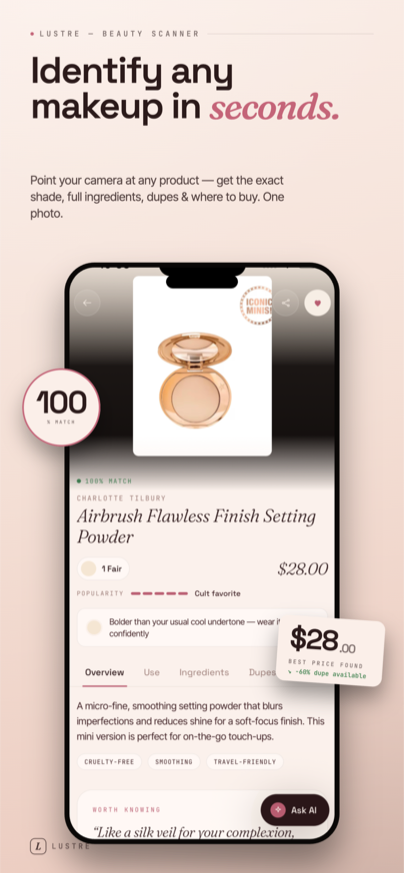
It works from the shelf side, too. Scan a foundation with True Shade and it identifies the brand, product, and exact shade with a confidence score, checks that shade against your undertone quiz, flags the ingredients, and lines up cheaper dupes across 600+ brands ranked by shade-match percentage. The jawline test tells you whether a bottle in your hand suits you; the scanner tells you which bottles are worth picking up at all.
For the wider decision — which foundation, not just which shade — our guide to finding your foundation shade covers the complete picture, from formula and finish through coverage.
The short version
- Your skin tone is two numbers: depth (how light or deep) and undertone (warm, cool, neutral). A match needs both.
- Test on the jawline in daylight, never the hand — and match toward your neck, not your face.
- Too light reads grey and chalky; too dark leaves a line at the jaw. A true match disappears without effort.
- Between two shades, wear-test both, lean lighter, or mix — and recheck undertone if they disagree on it.
- Wear a shade for a couple of hours before buying; oxidation is real.