If you've ever bought a foundation that looked perfect in the bottle and wrong on your face by lunchtime, you already know the problem: shade names lie. "Natural Beige" means five different things across five brands. Learning how to find your foundation shade properly — as a color measurement, not a guess — means you only have to do it once. After that, every foundation you consider, in any brand, becomes a simple yes or no.
This guide walks through the whole method: what a shade actually is, how to read your depth and undertone, how to test like a makeup artist, and how a foundation shade finder can do most of the work from a single photo.
A foundation shade is two measurements, not one
Every shade in every brand's lineup sits at the intersection of two axes:
- Depth — how light or deep your skin is, running from fair through light, medium, tan, and deep. This is the part most people get roughly right.
- Undertone — the hue beneath the surface: warm (golden, yellow, peachy), cool (pink, red, bluish), or neutral (a balance of the two). This is the part most people skip, and it's where nearly every mismatch lives.
Brands encode both in their shade codes. A "2W1" is depth 2, warm; MAC's "NC" and "NW" prefixes mean "neutral-cool" and "neutral-warm." Once you know your own coordinates, those cryptic codes turn into a map. Get the depth right but the undertone wrong, and the foundation will sit on your skin like a tint that doesn't belong — often the reason a face reads orange or ashy an hour after application.
Step 1: Find your depth
Depth is easiest to judge in soft, indirect daylight — face a window, no direct sun. Look at your jawline and the center of your chest, not your forehead or cheeks, which tan faster and run darker than the rest of you. Place yourself honestly on the fair-to-deep spectrum, and remember two things:
- Your depth moves with the seasons. Many people are a half to full shade darker in late summer than midwinter. Match to your skin as it is now, not as it was in a January selfie.
- Between two candidates, err slightly lighter for your first buy. Most formulas oxidize — they darken and warm as they react with your skin's oils. A hair too light at application usually settles right; a hair too dark only gets darker.
Step 2: Find your undertone
Undertone is the quiet half of how to match foundation to skin tone, and it doesn't change with the seasons — tan or pale, your underlying hue stays put. Three quick home checks triangulate it:
The vein check
In daylight, look at the veins inside your wrist. Greenish veins suggest a warm undertone; blue or purple suggest cool; if you honestly can't decide, you're likely neutral.
The jewelry check
Which metal flatters your skin rather than just sitting on it? Gold flattering warm, silver flattering cool, both equally fine pointing to neutral. Go by the skin around the metal, not by preference.
The white-fabric check
Hold a pure white shirt to your bare face. If your skin looks yellowish or golden against it, warm; rosy or pink, cool; simply "like skin," neutral.
No single test is conclusive — run all three and go with the majority. If they disagree or you want more signals (how you tan, which lipsticks work, which colors wash you out), our full guide to finding your skin undertone goes deeper.
SKIP THE GUESSWORK
Know your undertone in 60 seconds.
True Shade's quiz reads your undertone once — warm, cool, or neutral — then checks every foundation you scan against it, with the exact shade, ingredients, and cheaper dupes ranked by match.
Download True Shade freeStep 3: Test like a makeup artist
With depth and undertone in hand, narrow any shade range to your two or three closest candidates — then let your jawline decide. The jawline test is the industry standard for a reason: it's the border where face meets neck, so it exposes both a depth mismatch and an undertone clash at once.
- Swipe a stripe of each candidate from cheek down over the jaw onto the neck.
- Blend the edges lightly and wait ten to fifteen minutes — long enough for oxidation to start telling the truth.
- Step into daylight with a mirror. The right shade is the one you can't find anymore.
Which raises the classic question: should foundation match your face or your neck? The honest answer is both — that's exactly why you test at the jawline, the seam between them. Faces often run a touch darker or redder than necks; a shade matched to the cheek alone can leave a mask line. When the two genuinely differ, lean toward the neck and warm the face back up with bronzer, which looks far more natural than a pale neck under a darker face. Our guide to matching foundation to your skin tone settles this and the other perennial dilemmas in detail.
One more rule that outranks all others: judge nothing under store lighting. Retail fluorescents and warm boutique bulbs both shift color dramatically. Swatch in the shop if you must, then walk to a window or step outside before you decide.
How to find your foundation shade online
Testing in person works, but it assumes the counter stocks your brand, your shade, and a patient hour of your time. Increasingly, the faster route is digital. A modern foundation shade matcher works from one of two inputs:
- A reference shade you already trust. If one foundation matches you perfectly, conversion tools can translate that shade into other brands' ranges — from a MAC code to its nearest neighbors elsewhere — because underneath the naming systems, every shade is just a color value.
- A photo of your bare skin. AI shade finders sample the skin regions of a well-lit picture, estimate your depth and undertone, and rank real shades by closeness. Taken in indirect daylight with no flash or filters, the results land on or within one shade of a good counter match. We've written a full walkthrough of finding your foundation shade from a photo, including exactly how to take the picture.
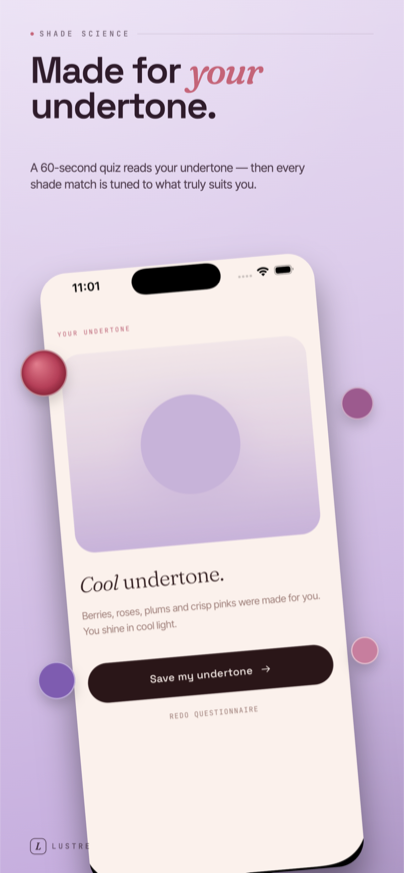
This is where an app like True Shade compresses the whole method into a habit. Take its 60-second undertone quiz once, then point the camera at any foundation — on a shelf, in a friend's bag — and it identifies the exact product and shade with a confidence score, checks it against your undertone, and lines up cheaper dupes across 600+ brands ranked by shade-match percentage. The three steps above still happen; they just happen in seconds.
Why a "matched" shade can still go wrong
Even a correct match can misbehave, and it helps to know the usual suspects before blaming your shade:
- Oxidation. Formulas darken and warm as they meet your skin's oils — the main reason foundation turns orange through the day. Judge shades after wear time, never straight from the bottle.
- Flashback and filters. SPF-heavy formulas can photograph paler than they look in person. Match for real life first, photos second.
- Skin in transition. A fresh tan, a flush, or post-treatment redness will skew any match — human or AI. Match your baseline skin.
- The wrong formula for your skin type. A perfect shade in a formula that breaks up or clings won't read as a match by afternoon.
The short version
- Your foundation shade is depth plus undertone — learn both once and every brand's range becomes readable.
- Judge depth at the jawline and chest in daylight; when torn, go slightly lighter to outsmart oxidation.
- Find your undertone with the vein, jewelry, and white-fabric checks — it never changes, so it's the best investment in the whole process.
- Test finalists on your jawline, wait fifteen minutes, and decide in daylight; the winning shade disappears.
- Online, a photo-based foundation shade finder gets you to the same answer in minutes — and translates it across brands.