Most people try to find a lipstick shade the way they'd pick a paint chip: hold up twenty options, squint, and hope one of them speaks. It rarely works, because a lipstick doesn't exist in isolation — it exists against your skin, your undertone, and your natural lip color. Change any of those and the "same" red becomes a different red.
The fix is to stop treating shade-finding as one big question and break it into three small ones, answered in order: undertone first, then depth, then finish. This guide walks through each decision, shows you how to build a small lipstick wardrobe that covers real life, and covers the modern shortcut — using a lipstick shade finder to identify a color you spotted on someone else.
Decision one: find your lipstick shade family by undertone
Undertone is the hue that sits beneath your skin's surface — warm (golden, peachy), cool (pink, rosy, bluish), or neutral (a balance). It doesn't change with a tan, and it's the single biggest reason a lipstick that looks stunning on a friend looks off on you. If you haven't pinned yours down, start with our guide to finding your skin undertone — it takes minutes and pays off across every product you'll ever buy.
Once you know it, whole shade families open up or quietly close:
- Warm undertones harmonize with orange-based and golden shades: brick red, terracotta, coral, peach, warm browns, caramel nudes.
- Cool undertones harmonize with blue- and pink-based shades: cherry and blue-based reds, berry, plum, mauve, rosy pinks, pink-leaning nudes.
- Neutral undertones can borrow from both sides — depth and finish become the deciding factors instead.
This is why "does red lipstick suit me?" is the wrong question. Almost everyone can wear red; the question is which red. A warm complexion in a tomato red looks lit from within; the same face in an icy blue-red can look drained. The lipstick color for your skin tone isn't a single answer — it's a family, and undertone names the family. For a deeper dive into specific pairings, see how to choose the right lipstick shade for your skin tone.
Decision two: use your natural lip color as the anchor
Here is the most underrated trick in all of lipstick shopping: look at your bare lips. Their natural color — rosy, mauve, brick, brown, deep berry — is the shade your face is already built around. Every flattering lipstick relates to it somehow.
The safest and most useful relationship is "your lips but better": your natural lip color, translated into a lipstick and turned up slightly — a touch deeper, a touch brighter, a touch more polished. It's the shade that makes people say you look well-rested rather than made-up, and it's the one tube that goes with everything you own.
From that anchor, depth becomes simple arithmetic:
- Within one step of your natural lip color — everyday shades. Effortless, forgiving, hard to get wrong.
- Two or three steps deeper or brighter — statement shades. Still harmonious because they share your undertone, but they read as a deliberate choice.
- Lighter than your natural lips — the danger zone. Nudes paler than your lips can flatten or grey out your whole face, especially on medium and deep skin. If you love a pale nude, warm it up with liner close to your natural lip color.
Depth also interacts with your overall coloring. Fair skin can be overwhelmed by very deep vampy shades in daylight; deep skin can make them look like velvet. Neither is a rule against anything — it just tells you which shades are effortless and which are a look.
SKIP THE GUESSWORK
Point your camera at any lipstick.
True Shade identifies the exact brand, product, and shade from one photo, checks it against your undertone quiz, and lines up cheaper dupes across 600+ brands — ranked by shade match.
Download True Shade freeDecision three: matte, satin, or gloss
Finish changes how a color behaves as much as the pigment does. The same berry reads dramatic in matte, easy in satin, and playful in gloss. Choose finish last, once undertone and depth are settled — and choose it for the occasion and the current state of your lips.
Matte
Maximum pigment, maximum staying power, minimum forgiveness. Matte formulas show every flake and dry patch, so they reward exfoliated, balmed lips. Best for long days, photos, and any shade you want to read as deliberate — a matte red is a sentence; a glossy red is a suggestion.
Satin
The everyday answer. Satin (and cream) finishes carry real color with a soft light-catching sheen, feel comfortable for hours, and blur small imperfections instead of broadcasting them. If you're building your first serious lipstick collection, start here.
Gloss
Light, dimension, and the illusion of fullness. Gloss suits lighter and sheerer shades best — deep shades in a slippery gloss tend to migrate. It's also the most forgiving finish for dry lips and the easiest to apply without a mirror.
A practical note on occasion: daytime and office settings flatter satin and sheer finishes at everyday depth; evenings tolerate — and reward — deeper depth and matte drama. If a shade feels like too much, changing the finish is often easier than changing the color.
Build a three-shade lipstick wardrobe
You don't need a drawer of forty tubes. You need three that were actually chosen:
- The everyday — your "lips but better" shade in a satin finish. Within a step of your natural lip color, in your undertone family. This one lives in your bag.
- The statement — your best red or bold, matched to your undertone: brick or tomato for warm, cherry or blue-red for cool, a true balanced red for neutral. Matte or satin.
- The deep — a berry, plum, brown, or wine two to three steps below your natural depth, for evenings and cold months.
Three shades, one undertone family, three depths, two or three finishes — and suddenly every outfit and occasion is covered. Everything you buy after this is pleasure, not necessity.
Saw the perfect shade on someone else? Identify it
Sometimes the search ends the moment you see a color on a stranger, a friend, or someone in a video — and the real problem becomes naming it. This is where an AI lipstick matcher earns its keep. Instead of describing "a sort of dusty rose but warmer?" to a sales assistant, you scan a photo.
Take or save a clear picture, and a scanner like True Shade will identify the likely brand, product, and exact shade with a confidence score — then check whether that shade actually suits your undertone, which is the step most of us skip in the excitement. If the original is out of budget or sold out, it ranks cheaper dupes by shade-match percentage, and you can ask its built-in beauty advisor whether the color will translate to your coloring. The full walkthrough is in our guide to identifying a lipstick from a picture.
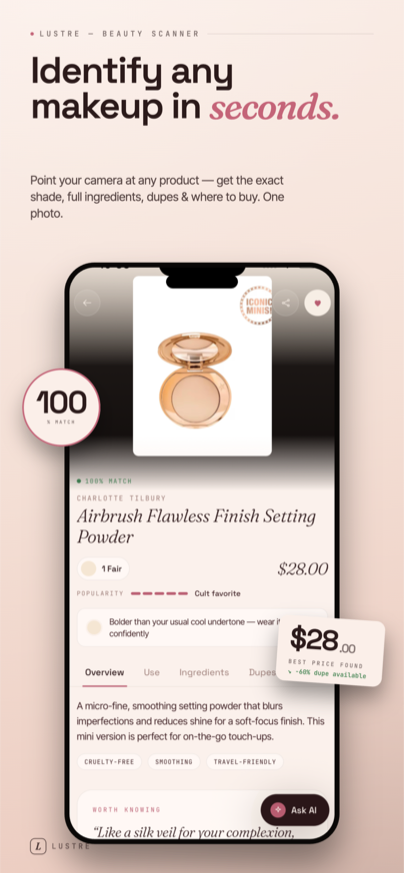
One honest caveat: lip color in a photo is the product plus the wearer's natural lip color plus the lighting. A shade that photographs as soft rose on one person may pull mauve on you. That's not a flaw in the tool — it's exactly why the undertone check matters, and why testing your top match on your own lips (or over your usual liner) is still the final word.
The short version
- To find your lipstick shade, decide in order: undertone → depth → finish. Never the reverse.
- Undertone names your shade family: orange-based for warm, blue- and pink-based for cool, most families for neutral.
- Anchor depth to your natural lip color — "your lips but better" is the everyday sweet spot; deeper is a statement; paler than your lips is the risk zone.
- Pick finish by occasion and lip condition: matte for drama and staying power, satin for daily life, gloss for light and ease.
- Three deliberate shades — everyday, statement, deep — cover almost everything.
- Spotted a shade in the wild? A lipstick shade finder can identify lipstick shades from a photo and check them against your undertone before you spend a cent.