Search for the best foundation for oily skin and you'll find a hundred ranked lists that quietly contradict each other. That's because "best" isn't a product — it's a set of properties. Once you know which finish, which claims, and which ingredients actually matter for oily skin, you can pick up any bottle in any store and judge it in thirty seconds, no listicle required.
This is that checklist. It works whether you're shopping a drugstore aisle or a department-store counter, and it works for whatever launches next year, too.
Start with the finish: matte, but read the fine print
Finish is the first filter, and for oily skin it does most of the work. Foundations generally come in three finishes:
- Dewy or luminous — adds glow. On oily skin, this reads as more shine on top of your own by lunchtime. Skip it.
- Natural or satin — sits between glow and flat. Workable for combination skin if you set the T-zone.
- Matte and soft-matte — absorbs and resists oil. This is your category.
Within that category, the useful distinction is flat matte versus soft-matte. A flat, full-coverage matte kills every trace of shine on application, but it can look mask-like in daylight and cling to dry patches or texture. A soft-matte keeps a hint of skin-like dimension — and, counterintuitively, it often looks better at hour eight, because the small amount of oil your skin produces during the day warms it into a natural satin instead of breaking through a rigid film.
If your skin is oily and textured or breakout-prone, soft-matte with medium, buildable coverage is almost always the safer buy than heavy full matte. Piling on coverage to outlast oil is one of the classic routes to a cakey finish — we break that failure mode down in why makeup looks cakey.
What the label claims actually mean
Foundation marketing has its own dialect. Here's the translation, claim by claim:
"Oil-free"
Means the formula contains no added oils — usually it's built on water and silicones instead. It does not mean the foundation controls your oil; it just doesn't contribute any. A good baseline for oily skin, but not sufficient on its own.
"Non-comedogenic"
Means the formula is designed not to clog pores. There's no regulated standard behind the word, so treat it as a signal of intent rather than a guarantee — the ingredient list (next section) is the more honest witness. Still, if you're acne-prone, its absence from a label is worth noticing.
"Transfer-resistant" and "transfer-proof"
Means the formula sets into a film that resists rubbing off on collars, phone screens, and masks. For oily skin this is a strong positive signal: the same film-formers that stop transfer also resist being broken up by oil.
"Longwear" / "16-hour" / "24-hour"
Means the formula was tested to stay visually intact for that span under test conditions — not that it will on your particular skin. In practice, longwear formulas are the most oil-resistant category on the shelf, and the wear-hour number matters less than the word itself. Expect them to need proper removal at night (an oil cleanser or balm), which is the fair price of the durability.
The strongest combination on a box, for oily skin, reads something like: oil-free, longwear, transfer-resistant, matte or natural-matte finish. Any two of those and you're in good territory.
CHECK BEFORE YOU BUY
Read the formula before the register.
Scan any foundation with True Shade and get its full ingredient list with risk flags — plus the exact shade for your undertone and cheaper dupes ranked by match. Thirty seconds in the aisle beats three weeks of breakouts.
Download True Shade freeIngredients: what helps oily skin, what works against it
You don't need a chemistry degree — you need to recognize about a dozen names. Ingredients near the top of the list are present in the largest amounts, so weight what you see accordingly.
Look for these
- Silica — the workhorse oil absorber. Soaks up sebum and blurs shine all day.
- Kaolin (clay) — absorbs oil and mattifies; common in formulas aimed squarely at oily skin.
- Starches (aluminum starch octenylsuccinate, rice or corn starch) — soft-focus oil control without heaviness.
- Film-forming silicones (dimethicone, trimethylsiloxysilicate, polypropylsilsesquioxane) — the "longwear" engine; they lock pigment down so oil can't lift it.
- Niacinamide — a skincare bonus that suits oil-prone skin over time.
Be wary of these
- Rich plant oils and butters high on the list (coconut oil, shea butter) — lovely for dry skin, counterproductive here.
- Isopropyl myristate and isopropyl palmitate — texture enhancers with a reputation for clogging pores on breakout-prone skin.
- Heavy emollient bases generally — if a formula is marketed as "nourishing" or "for dry skin," believe it.
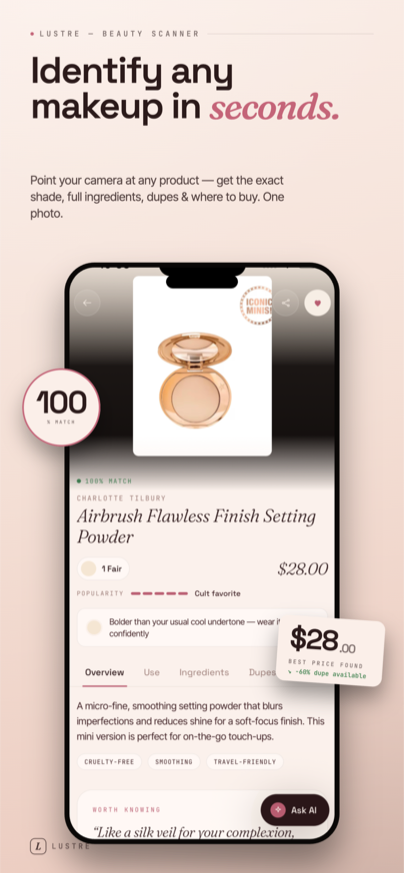
Reading a wrapped box in a store is the hard part, which is where a scan earns its keep: point True Shade at the foundation and it pulls the ingredient list with risk flags — a "Clean · no flags" badge when the formula comes up clear — before the product ever touches your skin.
Powder vs liquid foundation for oily skin
The old rule said oily skin should wear powder. The modern answer is more useful:
- Long-wear liquid is the most reliable choice for genuinely oily skin. Its film-formers are engineered to resist oil breakthrough, coverage is even and buildable, and it photographs well. This is the default.
- Powder foundation suits lighter-coverage days and shines at touch-ups — but as an all-day base on very oily skin it can go patchy where oil breaks through, and repeated layers over liquid build up into visible thickness.
- Cushions and sticks vary by formula; judge them by the same finish-and-claims checklist as any liquid.
The strongest everyday setup for makeup for oily skin is a hybrid: a long-wear liquid base, set once with a light dusting of loose powder, with a pressed powder in your bag strictly for the T-zone. If your current liquid pools or splits along your nose by afternoon, that's usually a formula-compatibility problem rather than an oil problem — see why foundation separates for the fix.
Application and touch-ups: technique is half the wear time
The same bottle can last four hours or ten depending on what you do around it.
- Moisturize anyway. A lightweight gel moisturizer, fully absorbed, stops your skin from over-producing oil to compensate for dryness. Skipping moisturizer backfires on oily skin.
- Prime the T-zone only. A mattifying primer where you shine first — forehead, nose, chin — and nothing where you don't. Priming the whole face flattens areas that didn't need it.
- Apply thin, then build. One sheer layer, let it set for a minute, then add coverage only where needed. Thin films bond to skin; thick ones sit on top and slide.
- Set where you shine. Powder the T-zone properly; barely dust the rest. Setting spray over the top helps meld the layers.
- Blot before you touch up. Through the day, press blotting paper (or a plain tissue) over shine before any powder. Powder over unblotted oil is the recipe for the thick 3 p.m. patch.
One last thing the lists never mention: the right formula in the wrong shade still fails. Oily skin plus a too-light shade oxidizes and separates more visibly than either problem alone, so nail the shade first — our complete foundation shade guide covers it — and remember that finish and formula rules shift with your skin type; the broader map is in choosing makeup for your skin type.
The short version
- Finish first: soft-matte or matte; skip dewy entirely.
- Best label combo: oil-free + longwear + transfer-resistant.
- Ingredients to seek: silica, kaolin, starches, film-forming silicones. To avoid: rich oils and butters up top, isopropyl myristate if you're breakout-prone.
- Long-wear liquid as the base; powder for T-zone touch-ups, not as the whole strategy.
- Thin layers, T-zone priming, and blot-then-powder buy you more wear hours than any single product swap.