Foundation separation is one of makeup's most maddening failures, because the product isn't necessarily bad — the chemistry underneath it is. Understanding why foundation separates comes down to one idea: foundation is an emulsion, a careful truce between water, pigment, and oils or silicones. Anything that breaks that truce — your own sebum, an incompatible primer, skincare that never absorbed — makes the formula split back into its parts, right there on your face. It pools in pores, gathers in creases, or rolls off in tiny crumbs.
The good news: separation leaves clues. What it looks like, and where it happens, almost always tells you which cause you're dealing with. This guide walks through the five big culprits, then diagnoses by zone — nose, chin, forehead — with a fix for each.
What foundation separation actually is
People use "separating" for three related but distinct failures, and it helps to name yours before fixing it:
- Breaking up — the foundation loses its even film and turns patchy, with skin showing through in irregular gaps.
- Pooling — product migrates and collects in pores, creases, and folds: the sides of the nose, the chin crease, forehead lines.
- Pilling — the foundation rolls into little balls or flakes under your fingers, sponge, or brush, usually within minutes of application.
Breaking up and pooling are usually a mid-day problem caused by oil or texture. Pilling is an application-time problem caused by incompatible layers. That distinction alone narrows your search by half.
Why foundation separates: the five main causes
1. Excess oil dissolving the formula
Sebum is a solvent for makeup. As your skin produces oil through the day, it seeps up into the foundation film and literally re-liquefies it, which is why foundation separating almost always starts in the T-zone. The oilier the skin — or the richer your morning moisturizer — the faster the film breaks. If this is your pattern, formula choice matters as much as technique; our guide to the best foundation for oily skin covers what to look for on the label.
2. A silicone-versus-water base mismatch
Primers and foundations are built on either a silicone base or a water base, and the two don't reliably bond. Lay a water-based foundation over a silicone-heavy primer (or the reverse) and the top layer can bead and slide instead of gripping — like water on a waxed car. The tell is makeup separating almost immediately, before oil has had any chance to interfere. Check the first five ingredients of both products: dimethicone or anything ending in -cone or -siloxane means silicone; water/aqua leading the list means water-based. Pair like with like.
3. Skincare that never absorbed
A sunscreen, serum, or cream that's still sitting on the surface becomes a slip layer between your skin and your foundation. The foundation bonds to the skincare instead of to you — and when that layer shifts, everything on top shifts with it. This is also the classic cause of pilling: unabsorbed film-formers roll up the instant a sponge drags across them.
4. Texture and dry patches
Foundation needs a smooth, evenly hydrated surface to form a continuous film. Flaky patches, rough texture, and clogged pores give it edges to cling to and gaps to collect in, so the product splits around them — dry skin can cause separation just as surely as oily skin, it just shows up as clinging and patchiness rather than pooling. (If your face looks more heavy and cracked than split, you're likely dealing with the related problem of cakey makeup.)
5. Too much slip in the stack
Every layer you add — moisturizer, sunscreen, primer, foundation, cream blush — brings its own emollients. Past a certain point the whole stack is simply too mobile to stay put, and your foundation not sitting properly is less about any one product than about the total. Thin every layer, or cut one entirely.
CHECK YOUR FORMULA
Find out what your foundation is actually made of.
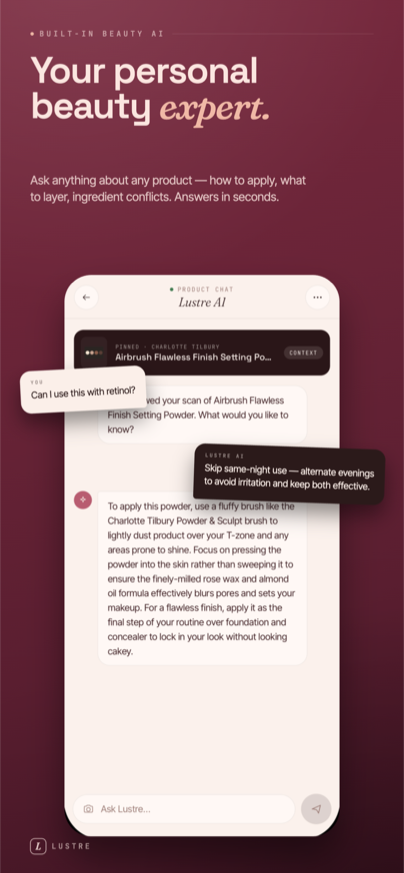
Scan any foundation with True Shade and get its full ingredient list — silicone or water base, risk flags, and a built-in AI beauty advisor you can ask why it's separating on your skin and what pairs with it.
Download True Shade freeDiagnose it by where it separates
Location is your best diagnostic tool. The same foundation can behave three different ways on three zones of the same face.
Around the nose
The most common complaint, and almost always oil plus movement. The sides of the nose are among the oiliest spots on the face, the creases catch pooled sunscreen and moisturizer, and it's the area we touch, blow, and blot most. The fix: apply your thinnest possible layer here, press it in with a sponge rather than swiping, and set immediately with a small amount of powder pushed into the creases. If you wear sunscreen, make sure it has fully set around the nostrils before anything goes on top.
On the chin
Chin separation usually means texture or touch. The chin collects congestion and rough patches that break the foundation film, and resting your hand on it through the day physically lifts product. The fix: gently exfoliate the area a couple of times a week, moisturize it well, and keep your hands off. If foundation gathers in the crease below your lip, press powder there before it migrates.
On the forehead
A forehead that splits by noon points to oil (if you're combination or oily) or to hairline products — leave-in conditioners and styling creams travel further than you think. Foundation breaking into horizontal lines here means it's settling into expression creases, often because the layer is too thick. The fix: mattifying primer on the forehead only, less foundation than you think you need, and keep hair products an inch back from the hairline until makeup is set.
Everywhere at once
If your foundation separates across the whole face — and especially if it pills as you apply — suspect the stack, not your skin: base mismatch, unabsorbed skincare, or simply too many mobile layers. Rebuild from the skin up, adding one product back at a time until you find the saboteur.
How to stop foundation separating: the routine that holds
Once you know your cause, the fix is mostly sequencing and restraint:
- Start with balanced skin. Lightweight, oil-free hydration for oily zones; richer cream only where you're genuinely dry. Skin that's comfortable produces less compensatory oil.
- Let every layer absorb. Give serums, moisturizer, and sunscreen two to three minutes each. If you can still slide a finger across your face, it isn't ready for foundation.
- Match your bases. Silicone primer with silicone foundation, water with water. When in doubt, read the first five ingredients of each.
- Apply thin and press. Two sheer pressed layers outlast one thick swiped one, every time. Stippling with a damp sponge builds a film; dragging with fingers disturbs it.
- Set strategically. Powder only where you separate — usually nose, chin, center forehead — not the whole face.
- Blot, don't re-layer. Mid-day, press oil away with blotting paper before touching up. Piling fresh foundation onto broken foundation just gives the oil more to dissolve.
And rule out the formula itself. Some foundations are simply wrong for your skin type — too emollient for oily skin, too matte for dry — and no primer will negotiate that peace. Our guide to choosing makeup for your skin type covers how to pick a base that works with your skin instead of against it. It's worth saying that separation is a texture problem, not a color one — if your foundation is turning the wrong shade rather than the wrong texture, you're looking at oxidation, which has entirely different causes.
If you're staring at a bottle wondering whether it's silicone- or water-based, or whether it plays well with your sunscreen, this is exactly what True Shade's scanner is for: point your camera at the product and it returns the ingredient list with risk flags, plus an AI advisor chat where you can ask, in plain language, why this particular formula keeps splitting on your T-zone.
The short version
- Foundation separates when its emulsion breaks — from your oil, an incompatible base, unabsorbed skincare, rough texture, or too many slippery layers.
- Pilling at application means incompatible layers; breaking up by mid-day means oil or texture.
- Read the location: nose points to oil and movement, chin to texture and touching, forehead to oil or hairline products.
- Match silicone with silicone and water with water, let skincare absorb fully, and apply thin pressed layers.
- Set only the zones that split, and blot instead of re-layering during the day.