You know the look: foundation that reads as a layer sitting on the face rather than skin itself. Texture where there wasn't any this morning. Creases collecting product by noon. If you've been asking why makeup looks cakey when the same products behaved perfectly last month, the honest answer is that cakiness is almost never one product's fault — it's an accumulation. Dry patches underneath, one layer too many on top, a primer that argues with your foundation, powder doing overtime.
The good news is that every cause has a specific, unglamorous fix. Below are the ten that account for nearly every case of cakey foundation, in roughly the order they happen — from your skin before makeup to the touch-up at 3 p.m.
What "cakey" actually means
Cake happens when makeup stops behaving like a tint and starts behaving like a coating. Foundation is designed to spread as a thin, flexible film that moves with your skin. When that film gets too thick, too dry, or too uneven — because the surface underneath was rough, or the layers on top never fused — it stiffens, settles into lines, and exaggerates every pore and flake it was meant to blur. That's why makeup looks dry and heavy at the same time: the film has cracked in some places and piled up in others.
Which means the fix is never "blend harder." It's finding which layer of the stack went wrong.
Why makeup looks cakey: the 10 causes and their fixes
1. Dry, unexfoliated skin underneath
Dead skin cells don't hold makeup the way fresh skin does — they grab pigment, drink up the liquids in your foundation, and lift at the edges, so product piles up around every flake. This is the single most common reason makeup looks dry and textured by midday.
The fix: gentle exfoliation two or three times a week — a mild chemical exfoliant or a soft washcloth, not an aggressive scrub the morning of a big event. Smooth skin is the difference between foundation gliding and foundation snagging.
2. Skipping moisturizer
Foundation applied to thirsty skin gets absorbed unevenly: the dry areas pull moisture out of the formula and leave the pigment behind as a chalky crust. Even oily skin cakes without hydration, because dehydrated oily skin produces more oil and more flakes.
The fix: moisturize every time, matched to your skin — a rich cream for dry skin, a light gel for oily — and give it two to three minutes to sink in before anything goes on top. Foundation should meet a hydrated surface, not a sponge-dry one.
3. Too much product
Most cakey faces are simply wearing two or three faces' worth of foundation. Full coverage applied everywhere — including the 80% of your face that didn't need it — creates a film thick enough to crack the moment you smile.
The fix: start with half of what you think you need. One thin layer all over, then spot-conceal only where something actually shows through. Coverage you build in thin passes always looks more like skin than coverage you pour on in one.
4. The wrong formula for your skin type
A velvet-matte, long-wear foundation on dry skin clings to every flake by lunchtime. A dewy, oil-rich formula on oily skin slides, breaks apart, and demands the heavy powdering that finishes the cake. Neither product is bad — it's a mismatch.
The fix: match finish to skin type. Dry skin wants hydrating, luminous formulas; oily skin wants lightweight, oil-free ones — our guide to the best foundation for oily skin breaks down exactly what to look for on the label. If you're not sure which camp you're in, start with choosing makeup for your skin type.
CHECK BEFORE YOU BUY
Is that foundation built to cake on you?
Scan any foundation with True Shade and see the full ingredient list with risk flags, whether the shade suits your undertone, and cheaper dupes across 600+ brands — before it ever touches your skin.
Download True Shade free5. An incompatible primer
Primers and foundations have chemistry — literally. A silicone-based primer under a water-based foundation (or the reverse) can make the two layers repel each other, so the foundation beads, patches, and pills as you blend. What looks like cake is really two products refusing to shake hands. The same mismatch is a leading reason foundation separates on the skin hours later.
The fix: pair like with like. Check the first few ingredients — silicones usually end in "-cone" or "-siloxane," water-based formulas lead with water/aqua — and keep primer and foundation in the same family.
6. Powder overload
Powder's job is to set makeup, not to bury it. Every pass of powder absorbs a little of the emollient that keeps your foundation flexible; dust on enough and the film goes rigid, matte, and thick — the textbook cakey finish, especially around the nose and under the eyes.
The fix: press — don't sweep — a small amount of powder only where you genuinely shine, usually the T-zone. Dry areas like the cheeks and eye area often need no powder at all. If you love a full-matte look, one light pass with a big fluffy brush beats three passes with a dense puff.
7. Not letting layers set
Skincare, sunscreen, primer, foundation, concealer — stacked wet-on-wet, they don't layer, they mix. The blend turns to a paste that drags, pills, and thickens as you work it.
The fix: give each layer 60–90 seconds before the next. Brush your teeth, pick your lip color, do anything — the pause is what lets each film settle so the next one glides over it instead of into it.
8. The wrong tools
Fingers deposit a lot of product fast and warm it unevenly; a dense, dry brush can leave streaks that tempt you into adding more foundation to fix them. More product to fix uneven product is the cakiness spiral in miniature.
The fix: a damp makeup sponge is the most forgiving tool there is — it sheers out foundation, presses it into skin, and drinks up any excess. If you prefer brushes, use a duo-fiber or buffing brush in light circles, and finish by pressing with a sponge.
9. Touching up over oil
The 3 p.m. mistake: shine breaks through, and you press powder straight onto it. Powder plus oil makes a paste, and each touch-up adds another stratum — by evening you're wearing geology.
The fix: blot first, always. A blotting paper (or a single tissue ply) lifts the oil off; then a whisper of powder if you still need it. Blotting alone often restores the finish with zero added product.
10. Product past its prime
Foundations are emulsions, and emulsions age. Past their period-after-opening (the little "12M" jar symbol on the packaging), the oils and pigments start to split — the formula goes thick, streaky, or strangely thin, and no technique can make a broken emulsion look like skin. An expired formula that's oxidizing can also shift color on you, the same chemistry behind foundation turning orange.
The fix: if the foundation smells different, has separated in the bottle, or needs a hard shake to recombine, retire it. Most foundations are happiest within 6–12 months of opening.
How to prevent cakey makeup before it starts
Run the list backwards and it becomes a routine. How to prevent cakey makeup, in one paragraph: exfoliate a couple of times a week, moisturize and wait, choose a formula that matches your skin type, keep primer and foundation chemically compatible, apply thin layers with a damp sponge and let each one set, powder only where you shine, blot before every touch-up, and check the age of anything that suddenly starts misbehaving.
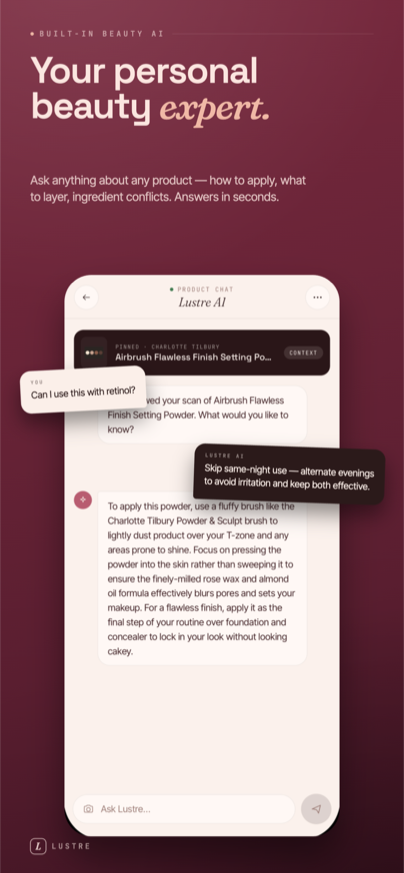
The hardest step for most people is the formula question — knowing whether a foundation will fight your skin before you've paid for it. That's a place a scanner genuinely helps: point True Shade at a foundation and it identifies the exact product and shade, shows the ingredient list with risk flags, and its built-in AI beauty advisor can tell you whether that specific formula tends to suit dry, oily, or combination skin — and line up cheaper dupes if it doesn't.
The short version
- Cakey makeup is a stack of small errors, not one big one — fix the skin first, the layers second.
- Exfoliate regularly, moisturize every time, and let it absorb before makeup.
- Half the foundation, applied in thin pressed layers, beats one heavy coat — spot-conceal the rest.
- Match formula to skin type and primer to foundation; mismatches patch and separate.
- Powder only where you shine, blot before touch-ups, and retire foundations past 6–12 months.